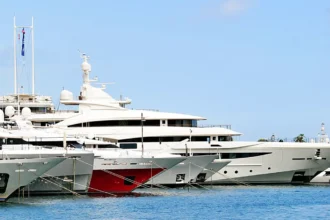
Charter guests boarding a fifty metre motor yacht in Antibes rarely glance at the small lettering on the stern that names her port of registry, and most could not say which country’s law governs the vessel they are about to spend a week aboard. Owners, their lawyers and their insurers think about little else. The flag state question sits near the centre of almost every ownership decision in yachting, yet for the person who has simply booked a charter, it is one of the least visible parts of the arrangement. Whether that invisibility is reasonable is worth answering properly rather than assuming either way.
What a flag state controls
A flag state is the country whose law a vessel operates under, regardless of where the owner lives or the yacht happens to be cruising that season. Under the international framework overseen by the IMO, the flag state enforces the major maritime conventions on its registered vessels: SOLAS for safety of life at sea, MARPOL for pollution prevention, STCW for crew certification, and the Maritime Labour Convention for welfare and working conditions.
In Britain’s case, the Maritime and Coastguard Agency administers this through the Red Ensign Group Yacht Code, successor to the old Large Yacht Code, which the UK has formally notified to the IMO as an equivalent standard.
In practice, this means the flag state decides who surveys the yacht, how often, and against which construction and safety standard. None of this is visible from the saloon, but it determines whether the yacht a charterer has booked is legally entitled to be carrying paying guests at all.
Why owners pick the registries they do
Most large yachts are not flagged in the country where their owner lives. Cayman Islands, the Marshall Islands and Malta dominate the market, alongside the wider Red Ensign Group of British territories and crown dependencies, which brokerage firm Edmiston has estimated carries as much as eighty per cent of the large yacht fleet. The reasons are rarely about safety standards, which converge closely across the serious registries, and much more about tax treatment, confidentiality of ownership, and standing on the Paris MoU white list that governs how often a vessel is boarded for port state inspection.
Malta’s appeal within the EU rests heavily on VAT and leasing structures, while Cayman and the Marshall Islands suit owners wanting British or American-style legal backing without EU tax exposure. A yacht’s flag often says more about its owner’s financial structuring than about anything a guest would notice on deck.
Commercial registration changes the rules, not the flag
For a charterer, the flag flying from the transom matters less than whether the yacht holds a commercial, or charter, endorsement at all. A private yacht and a commercially registered one answer to very different standards even under the same flag. Commercial endorsement under the Red Ensign Yacht Code, Malta’s equivalent code, or the Marshall Islands’ charter provisions requires more rigorous surveys, a formal safe manning document, and insurance written for commercial carriage rather than private use.
A yacht that has not cleared this bar should not be taking paying guests, whatever flag it carries, and this is the detail worth a charterer’s attention. A reputable broker will not put a client on a yacht without the correct papers, but it remains a fair question to ask before booking, since it speaks directly to the insurance and liability position the guest will be operating under for the week.
Crew certification and the MCA question
A persistent assumption among charter guests is that an MCA-certified crew, trained under British standards, represents a meaningfully higher bar than crew certified elsewhere. The reality is less dramatic. STCW is an international convention, and the certificates it produces are recognised across almost every serious maritime jurisdiction regardless of which flag ultimately employs the crew. The REG Yacht Code and its Maltese or Marshallese equivalents all reference the same underlying STCW framework rather than inventing separate competency regimes.
Where the flag does matter is enforcement discipline, how rigorously medicals, manning levels and hours of work and rest are checked, which is a harder thing for a charterer to assess than simply noting which flag the yacht flies.
Where the flag quietly does shape a charter booking
There are places where flag choice does reach the guest, even if indirectly. A non-American-flagged yacht generally cannot carry paying passengers between two American ports because of long-standing coastwise trade restrictions, part of why so much Caribbean and Bahamian charter business routes around continental American waters rather than through them.
Within the European Union, a non-EU flagged yacht chartering in the Mediterranean typically needs a specific VAT and import arrangement to trade legally, and the smoothness of that arrangement varies by flag. None of this changes the week on board, but it can shape which itineraries a given yacht is realistically able to offer, a question that, as this magazine has argued before, often matters more to a charter’s success than the yacht itself.
Insurance, liability and whose law applies
If something goes wrong during a charter, a dispute rarely comes down to flag law alone. Boat International’s own legal guidance on chartering superyachts notes that where an incident occurs in a foreign port, both the law of the flag and local territorial law typically come into play, with territorial jurisdiction usually taking precedence when the two conflict.
The MYBA Charter Agreement, the industry’s standard contract, sits on top of all this and governs liability between charterer and owner directly, which is why most practical disputes are resolved within that contract rather than by reference to the flag. For a charterer, the contract in front of them matters considerably more than the ensign on the stern.
The honest answer
Flag state is a consequential decision for an owner, shaping tax exposure, financing, resale value and where the yacht can legally earn charter income. For the person booking a week aboard, it matters far less directly than the industry’s own preoccupation with it might suggest.
What protects a charterer is less the flag itself and more what sits beneath it: a valid commercial endorsement, crew holding recognised STCW certification, current safety and insurance papers, and a properly drawn charter contract. A good broker checks all of this as a matter of course, and a curious charterer is entitled to ask about it too, but choosing a yacht on the strength of its flag alone would be solving the wrong problem. The flag tells you where the paperwork lives, not whether the week ahead will be a good one.